
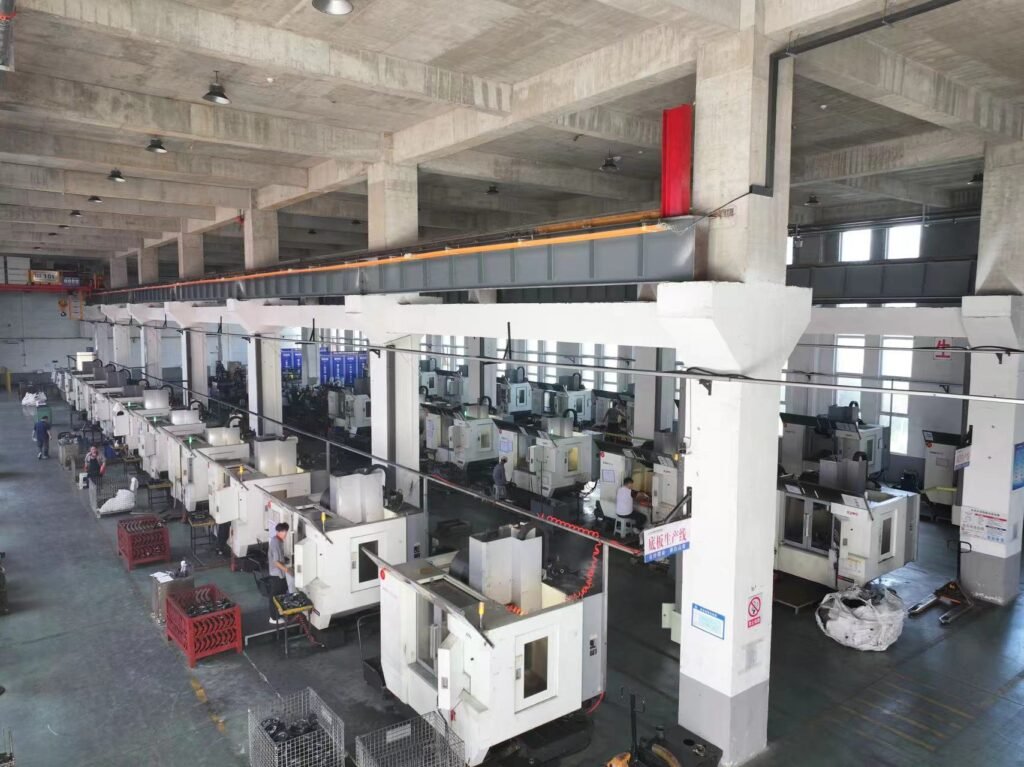
I. Integrated Machining Center: A Process Revolution Breaking Cumulative Errors
In traditional manufacturing, the stamping of the brake backplate and the welding of the brake shoe are often carried out independently. The assembly dimension chain is highly susceptible to the accumulation of tolerances from each process.
RENHE breaks the routine by utilizing advanced machining centers to perform integrated, synchronized machining on both the brake backplate and the brake shoe. Under a single clamping and positioning setup, critical hole positions, locating pin surfaces, and arc surfaces are cut and finely carved by high-precision CNC machine tools. This process establishes an absolute geometric positional relationship between components from the source, achieving a high standard of consistency. Whether within a single batch or across large-scale mass production, a highly unified technical state is maintained.
II. Micron-Level Dimensional Control: The Mechanical Ultimate Within 0.1mm
After the drum brake assembly is completed, the geometric tolerances of the mechanical structure directly determine the uniformity of force during the braking moment.
- Perpendicularity Controlled Within 0.1mm: After assembly, the perpendicularity between the working surface of the brake shoe and the central axis of the backplate is strictly limited to within 0.1mm. This means that during braking, the brake lining can perfectly fit the inner wall of the brake drum in an absolutely parallel posture, avoiding uneven wear caused by localized stress concentration.
- Runout Controlled Within 0.1mm: The overall rotational and fitting runout is also locked within a minute range of 0.1mm. Achieving this indicator effectively eliminates steering wheel judder and body resonance generated by the vehicle during high-speed braking, making the braking process more linear and smoother.
III. Top-Tier Friction Linings: The Balance of Wear Resistance and High Efficiency
As the core component where physical friction directly occurs, the brake linings equipped in this drum brake utilize advanced low-metallic and ceramic-based composite materials. Its friction coefficient remains stable within the industry’s recommended golden range even when subjected to continuous high-intensity friction at high temperatures (e.g., 350°C-400°C), showing no fear of thermal fade. At the same time, its wear rate indicator reaches the top level in the industry. While providing powerful braking resistance, it significantly extends the service life of both the brake shoes and the brake drums, offering highly cost-effective chassis protection for heavy-load, long-distance transportation.